
(like me)
For the nerds
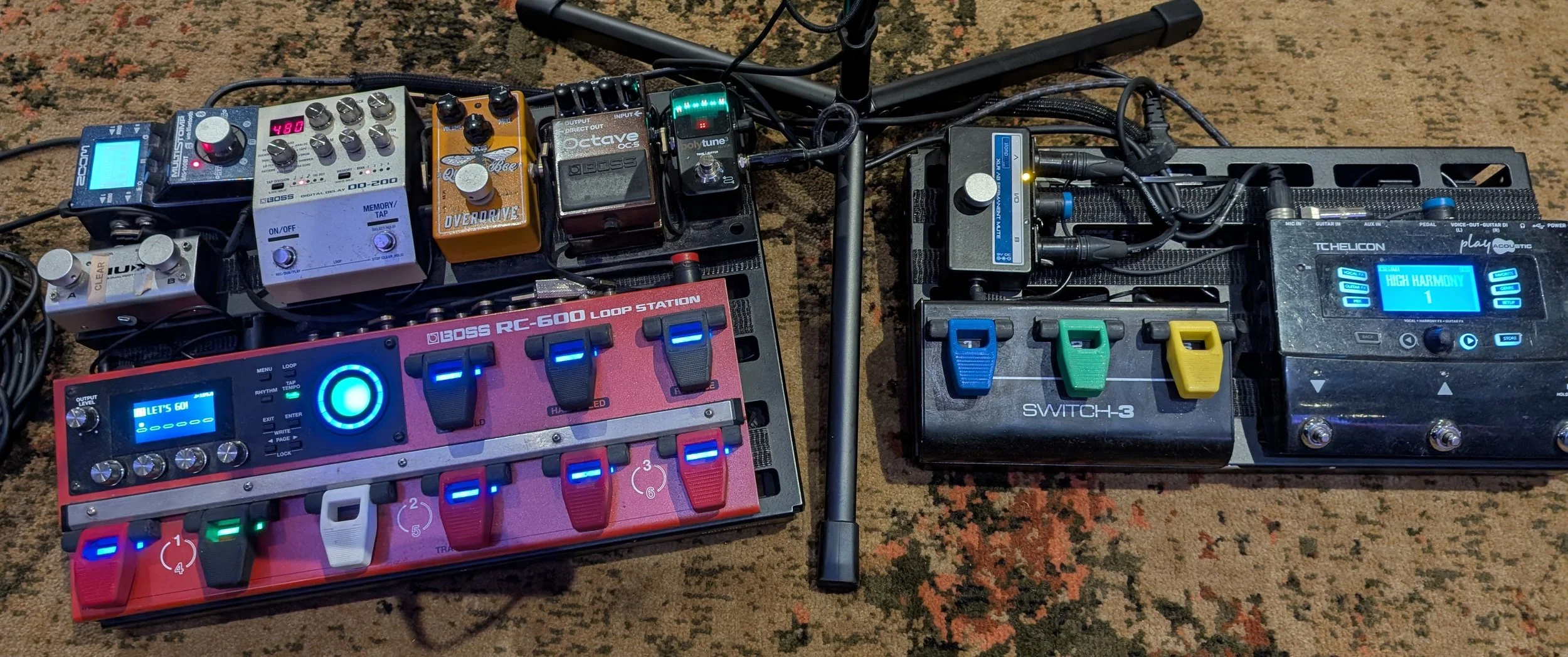
The Gig Rig
THE LOOPING BOARD (left side)
Sitting on a Rockboard 4.1 (with installed Mod 3 V2) is:
TC Polytune 3 Noir Mini Tuner
Boss OC-5
Caline Queen Bee Overdrive
Boss DD-200
Zoom 100-BT (discontinued, but still rocking out after over a decade!)
RC-600
Nux Switch-2
Fender Engine Room 12 power supply
Signal chain is primarily in the order above, however there are tweaks:
Boss OC-5 pedal.
The main OUTPUT leads directly into the RC-600 Input 1 (L) so that it is not effected by any of the subsequent effects in the chain. I do not want the bass signals generated to be effected by the overdrive or reverb pedals.
I run the DIRECT OUT (which is a clean signal, unprocessed by the OC-5) into the Caline Queen Bee:
Boss DD-200 delay.
I have this connected via midi to the RC-600, to receive the timing clock so it automatically syncs the delays to suit to active loops.
This then connects to the RC-600 Input 2 (R).
Nux Switch-2
connected to the RC-600, I have 2 quick actions set with
"A" programmed as a CLEAR ALL CHANNELS
"B" programmed as a UNDO
I've also reprogrammed the RC-600 button layout to suit my needs. I love that it’s customisable like that.
Since this photo, I have also added pedal toppers that make it really feel more like the RC-300 which I love.
The Mod 3 added is vital to this board’s setup. You can set up the ports to be input/output to suit your needs.
3 TS OUTPUTS are used for:
one signal to be sent to the VOCAL BOARD
one signal to be sent to the MIXER
a spare one so when Taylor is singing with me (I’ve built her a duplicate Vocal Board) she can also receive the guitar signal for her harmonies.
XLR INPUT receives a signal from my VOCAL BOARD so I can also loop vocals as needed
The Fender Engine Room 12 powers this board, but also has an IEC Power Out, which I connect to the VOCAL BOARD.
The benefit of this is only 1 x IEC cable is needed then to connect to power.
THE VOCAL BOARD (right side)
Sitting on a Rockboard 3.0 board (with installed Mod 3 V2) is:
TC Helicon Play Acoustic
TC Helicon Switch-3
Stompbeat Aus XLR A/B popless switch
Swamp ISO-10 Power Supply connected to the 3 pedals
this in turn, is connected to the Mod 3 module for IEC power connection.
This is really the only reason I added the Mod 3 to this board.
Starting the signal chain from the single vocal mic, this connects directly into the Play Acoustic pedal.
From here, the Play Acoustic Voice Out XLR is to the input of the A/B Switch.
From the A/B Switch, I have 2 XLR out cables -
connected to output A, is a direct XLR to the mixer. This acts as my main vocal signal.
This means I can sing independently while building and creating loops, without recording my vocals.
This also means I can independently adjust my main vocal gain structure to suit the venue and PA etc.
connected to output B, is an XLR which connects to the Looping Board.
This means that if I want to loop vocals, I can do so without sacrificing my audio tone and effects that I get from the Play Acoustic.
I also don’t need to have that awkward two-microphone setup (which I have done in the past)
Finally coming into the Play Acoustic, I also have a guitar cable running into the guitar input, connected from one of my 3 Looper Board Outputs (from the Mod 3)
This is so the Play Acoustic can always “listen” to whatever is playing, whether it’s a live guitar part, or a looped one.
To enhance the feature set of the Play Acoustic pedal, I also use the Switch-3 to control my desired effects:
Button 1=Tap Tempo
Button 2=Momentary delay
Button 3=HIT on/off for the selected harmony effect
Purchase and / or Affiliate Links
TC Electronic POLYTUNE 3 NOIR https://amzn.to/4bf8DSr
TC-Helicon Switch-3 Pedal https://amzn.to/3YV2lQF
Boss OC-5 Octave https://amzn.to/4plf0Hm
Caline CP-503 Queen Bee Overdrive https://amzn.to/4pm09fI
BOSS DD-200 Digital Delay https://amzn.to/49jbl6X
NUX NMP-2 Dual Foot Switch https://amzn.to/4susrrw
TC Helicon Play Acoustic https://amzn.to/3N1VGBz
BOSS RC-600 Loop Station https://amzn.to/4q2M9IV
RockBoard Module 3 https://amzn.to/4sq9Kow
Rockboard Pedalboards - Choose the size to suit your setup. Domestic retailers are often cheaper than Amazon so shop around. I recommend the flight case options if you can get it, otherwise some cases from Bunnings will also fit. Measure twice - buy once! :)
XLR A/B Switch XLR AB Switch with LEDS - Popless
Trade Prices for LD, Gravity and more
I have a trade account with the Australian distributors of:
LD Systems - for great live music and DJ sound
Gravity - for your gear transport, storage and accessories
Presonus - for your studio, recording and podcasting setups
- email chris@find2uned.com.au with your gear requirements and I’ll send you a quote!